
Can Vending Create Passive Revenue for Your Business?
Can vending create passive revenue for your business?
Sometimes. But the more important question is whether the program creates enough demand, convenience, and operational value to deserve the space it occupies.

A professionally managed vending or unattended retail program may create incremental revenue for a qualified host location. But revenue participation is never automatic, and it should not be the only reason a facility considers the service.
The economics depend on actual purchasing activity, population, operating hours, product demand, equipment requirements, service frequency, and the structure agreed between the facility and operator.
The stronger business case is usually broader: give people convenient access to products they need, reduce management burden, improve the experience inside the facility, and create a retail program that performs responsibly over time.
The right program should create value for the facility even before revenue participation is considered.
What does passive revenue mean in a vending relationship?
For a host business, passive revenue generally means receiving an agreed share of sales or another economic benefit without operating the equipment internally.
The vending operator manages equipment, inventory, restocking, payment systems, product decisions, cleaning expectations, and service issues. The host provides a qualified location, access, utilities where required, and an environment capable of supporting customer demand.
That arrangement can feel passive to the facility because the operator performs the day to day retail work. It does not mean the program creates revenue without sufficient sales.
The location creates access
The facility provides a real customer population and a useful point of convenience.
The operator runs the retail system
Equipment, products, servicing, payment systems, and performance adjustments remain professionally managed.
Sales determine what is possible
Revenue participation depends on whether the account economics can support it after equipment and operating costs.
The business benefit goes beyond a commission check
A vending program can create value even when direct revenue participation is modest or not part of the arrangement.
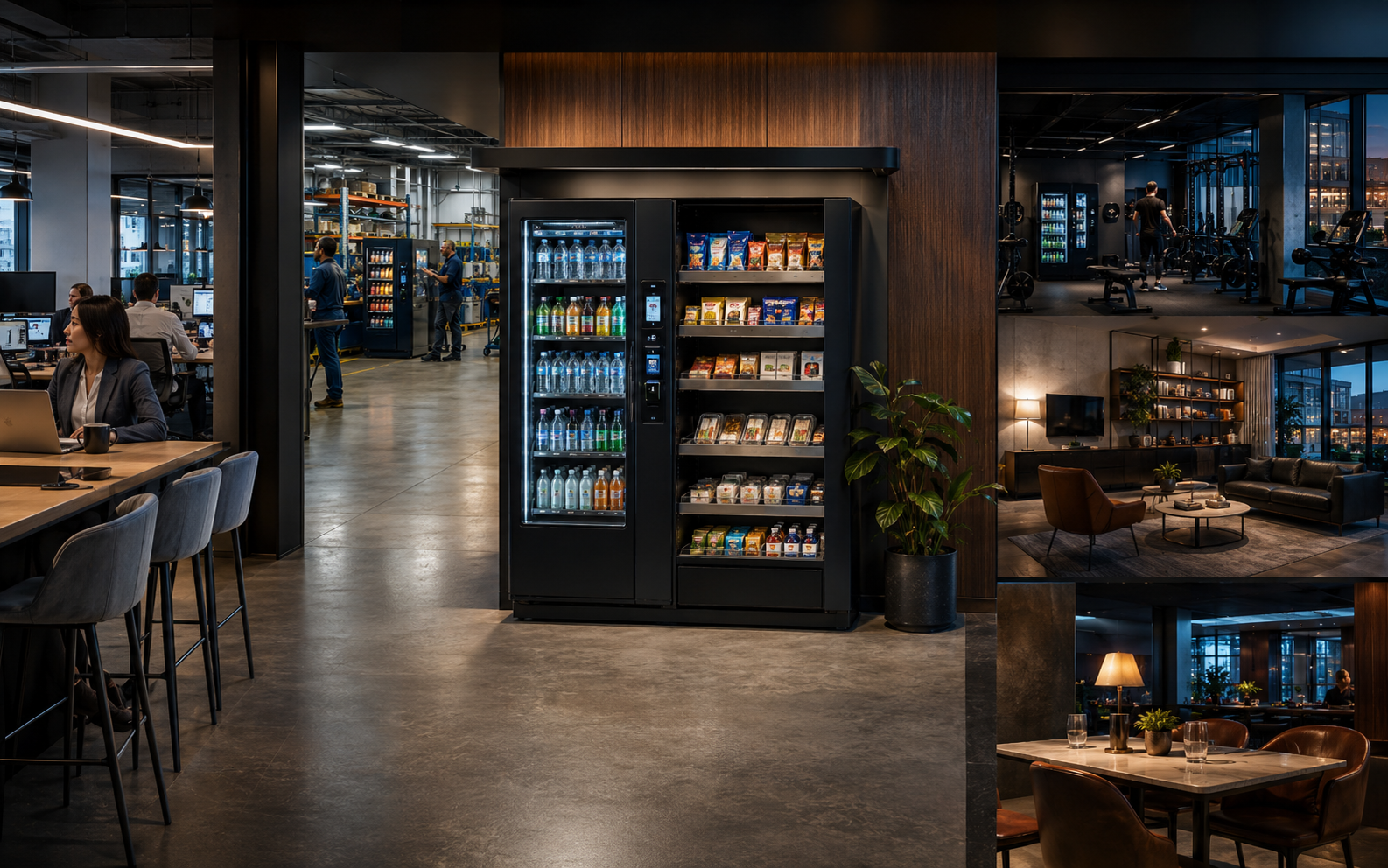
Employees may gain access to food and drinks without leaving the property. Residents may have convenient after hours options. Athletes and families may find hydration, recovery products, and forgotten essentials. Guests may have access to practical convenience items at the moment they need them.
The facility gains an amenity without becoming responsible for purchasing inventory, maintaining equipment, collecting payments, or resolving routine retail issues.
Convenience without internal staffing
The facility can offer on site retail access without creating another program for employees to operate.
A better employee or customer experience
Useful access to food, drinks, essentials, or facility specific products can strengthen the everyday experience.
Fewer off site trips
On site availability can reduce the need to leave during a shift, practice, appointment, or visit.
Better use of existing space
A properly placed retail program can turn an underused area into a useful service point.
Revenue starts with a program people actually use
A machine does not create value simply because it has been installed. The retail system must fit the people, traffic, schedule, placement, and needs of the facility.
Qualified demand
How many people have access, how often they are present, and whether there is a repeated reason to buy.
Useful placement
Visibility, convenience, security, power, connectivity, and service access influence performance.
Curated assortment
The products should reflect the actual location rather than a generic vending template.
Reliable operation
Stocking, cleanliness, payment reliability, issue response, and product review determine whether trust grows or disappears.
Curated retail is more valuable than generic product filling
Every shelf, selection, and cooler row represents limited retail space. Operation Vend Pro does not treat that space as a place to load whatever is easiest to source.
A warehouse may need hydration, energy, substantial snacks, and shift friendly meals. An office may support breakfast, coffee, better for you products, and convenient lunches. A sports facility may support electrolytes, protein, recovery products, family friendly snacks, and selected equipment essentials. A hospitality location may support chargers, personal care items, mints, or other convenience products.
Outside the box only works when the need is real. Interesting products do not automatically deserve space. Products stay because they solve a repeated need and earn repeat sales.
Workplaces
Breakfast, beverages, convenient lunches, familiar snacks, and products requested by employees.
Warehouses and manufacturing
Hydration, energy, substantial snacks, and food options that support multiple shifts.
Sports facilities
Water, electrolytes, protein, recovery products, family friendly choices, and selected forgotten essentials.
Hospitality environments
Practical nonfood products such as charging accessories and personal convenience items when demand supports them.
Not every location supports the same revenue structure
A responsible operator should evaluate the account before discussing a specific economic arrangement. A high traffic warehouse with multiple shifts is different from a small office with limited daily attendance. A large sports facility with tournaments and camps is different from a private residential amenity with controlled access.
| Factor | Why it matters | What should be reviewed |
|---|---|---|
| Daily population | More qualified users can create more purchasing opportunities. | Employees, residents, members, guests, visitors, and event traffic. |
| Operating schedule | Long hours and multiple shifts can increase the number of buying occasions. | Peak periods, overnight access, weekends, camps, tournaments, and seasonal changes. |
| Nearby alternatives | Convenience is more valuable when food or retail options are limited. | Walkability, break duration, off site travel, and internal food service. |
| Product mix | Products that fit the audience are more likely to earn repeat sales. | Requests, price points, package sizes, fresh food demand, and specialty categories. |
| Service requirements | Equipment, stocking frequency, travel, maintenance, and technology affect operating cost. | Machine type, refrigeration, connectivity, security, access, and service cadence. |
How a facility should evaluate the opportunity
The right process begins with the facility, not with a promise about income.
Assess the location
Review population, traffic, operating hours, access, space, power, connectivity, and nearby alternatives.
Select the format
Determine whether vending machines, a smart cooler, a micro market, or a combined system is appropriate.
Design the assortment
Build the opening mix around the actual audience, then refine it through sales and feedback.
Discuss economics honestly
Evaluate whether revenue participation is sustainable after equipment and operating requirements are understood.
Evaluating vending opportunities in Bucks and Montgomery Counties
Operation Vend Pro evaluates modern vending, smart cooler, micro market, and curated retail opportunities for qualified facilities throughout Bucks County and Montgomery County, Pennsylvania.
The recommendation depends on the location. The goal is not to place the most equipment. It is to build the most responsible retail program the facility can support.
Start with the facility, demand, and operating fit
If you are considering vending as a new amenity, an upgrade, or a potential source of incremental revenue, begin with a realistic review of the location.
Operation Vend Pro will assess what the facility can support, which retail format makes sense, and whether the account economics justify a broader conversation about revenue participation.
Questions about vending revenue and facility value
Can a business make money by hosting vending machines?
A qualified host location may receive revenue participation when sales volume and account economics support it. The arrangement depends on traffic, equipment, service requirements, product mix, operating costs, and the agreement between the facility and operator.
Is vending revenue truly passive for the facility?
It can require very little day to day involvement from the facility when a professional operator manages equipment, stocking, payment systems, maintenance, and service issues. The facility may still need to provide access, utilities, communication, and an appropriate operating environment.
Does every vending location receive commission?
No. Commission or revenue participation is not automatic. It should be discussed after the operator understands expected demand, equipment investment, service frequency, product costs, and other account requirements.
What makes a location more likely to support a strong program?
Useful indicators include a consistent daily population, long operating hours, multiple shifts, limited nearby alternatives, visible placement, secure access, reliable power or connectivity, and repeat demand for convenient products.
Can products other than snacks and drinks be included?
Yes, when the location and customer demand support them. Depending on the environment, the program may consider fresh food, recovery products, personal essentials, sports equipment, charging accessories, or other practical items. Products should remain only when they solve a real need and sell consistently.
Which format creates the most value?
There is no universal answer. Traditional vending may be the responsible fit for one facility, while another may support a smart cooler, micro market, or combined program. The right choice depends on population, space, security, product demand, and operating economics.
Vending can create incremental revenue. But revenue is the result of a useful retail program, not the reason a weak location suddenly becomes strong.
The better opportunity begins with convenience, demand, professional operation, and products people actually buy.
Let the economics follow.
